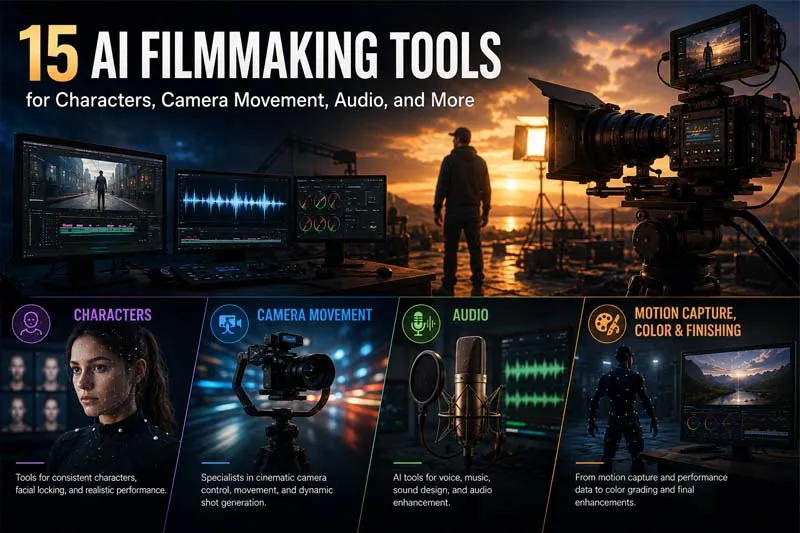

15 AI Filmmaking Tools for Characters, Camera Movement, Audio, and More
AI filmmaking tools tend to specialize hard: a tool that's excellent at locking a character's face across a hundred frames usually has nothing to say about camera motion, and a tool built around cinematic camera control usually treats voice as an afterthought. That specialization is useful to know going in, because it means the right tool depends entirely on which specific problem is actually blocking a project right now.
This list is organized around four categories instead of one flat ranking: one flagship tool that spans all of them, then specialists for characters, camera movement, audio, and a final group covering motion capture, color, and finishing.
Comparison table
| Tool | Category | Best for | Starting price |
|---|---|---|---|
| invideo agent | All categories | A full pipeline spanning character consistency, camera work, and audio in one project | $17/month; team and enterprise options available |
| OpenArt AI | Characters | Custom-trained models for a recurring character at scale | ~$7/month |
| Leonardo AI | Characters | Locked facial proportions across concept art and stills | Free tier; $12/month |
| DomoAI | Characters | Anime and stylized character consistency across animated sequences | ~$6.99/month |
| Moonvalley (Marey) | Camera movement | Commercially safe, camera-adjustable generation on licensed footage | $14.99/month |
| Luma Dream Machine | Camera movement | Physically convincing camera motion via 3D-space-aware architecture | ~$30/month |
| Genmo | Camera movement | Open-weight camera control without a black-box model | Free; $10/month |
| ElevenLabs | Audio | The most stable voice clone for extended narration | $5/month |
| Descript | Audio | Transcript-based dialogue editing and voice correction | $12/month |
| Resemble AI | Audio | Speech-to-speech conversion preserving a full performance | Pay-as-you-go from $0 |
| Move.ai | And more | Broadcast-grade motion capture from consumer cameras | From $0.012/second |
| Wonder Dynamics (Flow Studio) | And more | Mocap composited directly into live-action footage | Free tier; $45/month |
| Colourlab AI | And more | Automated shot matching and cinematic color grading | ~$15/month |
| World Labs Marble | And more | Persistent 3D environments for frame-perfect camera staging | Free tier; $20/month |
| Topaz Video AI | And more | Upscaling, denoising, and stabilizing the final master | $299/year |
The flagship: invideo agent
Every other tool on this list solves one category well and has little to say about the other three. invideo agent is built to span all of them in a single project, routing each shot to whichever of its 200+ integrated models fits that particular moment, including Veo 3.1, Sora 2, Kling 3.0, Seedance 2.0 , Runway, PixVerse, Hailuo, WAN, Recraft, GPT Image 2.0, and Nano Banana.
A persistent context engine handles the character side: a locked reference sheet carries a character's identity across every scene, session, and even multiple episodes of a series, rather than needing to be rebuilt each time a new shot comes up. Camera Controls handle the second category, letting a director choose a specific, deliberate move, a dolly-in, an orbit, a crash zoom, and hold that same choice consistently across a sequence. And Post & Finishing covers the third, voiceover, voice cloning, sound, and timeline editing, inside the same project that generated the picture, which matters most when a project needs to localize into a new language while keeping the same voice recognizable.
Best for: productions that need character consistency, camera work, and audio handled together in one continuous project rather than across three separate specialist tools.
Where it falls short: a team with one narrow, well-defined problem, matching color across a handful of clips, for instance, may find a single-purpose specialist faster to pick up for that one task alone.
Pricing: plans start at $17/month, with team and enterprise options also available.
Category: Characters
2. OpenArt AI
OpenArt's custom LoRA training lets a creator upload reference images of a character once, train a personalized model from them, and generate that character across unlimited future stills and short videos without rebuilding the asset for every new project.
Best for: a recurring character that needs to appear across a large volume of shots or several projects.
Where it falls short: it's a heavier upfront step than a simple reference upload, and output consistency varies across the underlying models it aggregates.
Pricing: plans start around $7/month.
3. Leonardo AI
Leonardo's Character Reference tool locks a protagonist's face shape, proportions, and features across every still image in a project, which has made it a standard choice for concept art and marketing stills before a single frame of video gets generated.
Best for: locking a character's visual design during concept development.
Where it falls short: it's a stills tool rather than a video generator, and the reference feature can lose specific traits across a long session.
Pricing: free tier with 150 daily tokens; paid plans from $12/month.
4. DomoAI
DomoAI is built specifically for anime and stylized animation, letting a creator upload a reference image or character sheet that guides every subsequent Image-to-Video or Frames-to-Video generation, with faces staying recognizable through simple movements like head turns or walking loops.
Best for: anime and stylized-animation creators making a recurring character-driven series.
Where it falls short: more complex motion or scenes can still soften facial features or distort patterned clothing, and results vary enough that multiple attempts per shot are common.
Pricing: plans from roughly $6.99/month.
Category: Camera movement
5. Moonvalley (Marey model)
Moonvalley's Marey model is 3D-aware, keeping camera angle and background elements adjustable even after a clip is generated, and it trains exclusively on licensed footage, which is why agencies producing paid campaigns specifically reach for it.
Best for: commercial productions needing legally clean, adjustable camera paths.
Where it falls short: clips are capped at up to 10 seconds, so longer sequences need multiple generations.
Pricing: Standard plan at $14.99/month for 100 credits.
6. Luma Dream Machine
Luma's Camera Motion SDK gives fine control over truck, dolly, pan, tilt, and roll moves, built on an architecture that blends diffusion transformers with NeRF-style 3D-space reasoning, which is why its camera motion tends to look unusually physical.
Best for: believable camera motion on a single scenic, architectural, or product shot.
Where it falls short: complex scenes with heavy simultaneous motion can still break physical coherence.
Pricing: Plus plan from roughly $30/month.
7. Genmo
Genmo's Mochi 1 model is fully open-weight under Apache 2.0, and its Replay model adds dedicated camera motion and FX control, pans, zooms, tilts, rolls, so camera language doesn't have to be guessed at inside a blank text prompt.
Best for: developers and researchers who want camera-aware generation on a model they can run and customize themselves.
Where it falls short: clips are capped at 5.4 seconds, and physics on complex motion can still look off.
Pricing: free plan with starting credits; Lite plan at $10/month.
Category: Audio
8. ElevenLabs
ElevenLabs' Professional Voice Cloning trains on longer samples specifically so a cloned voice holds up across extended narration rather than drifting on unusual phrasing, with cross-language cloning preserving the same speaker identity across 70+ languages.
Best for: long-form narration and multilingual voice consistency.
Where it falls short: Professional Voice Cloning sits behind the Creator plan, and the credit system makes real monthly cost easy to underestimate.
Pricing: Starter plan from $5/month; Professional Voice Cloning requires the $22/month Creator tier.
9. Descript
Descript's Overdub clones a creator's own voice so a flubbed line can be fixed by editing text rather than re-recording, and its transcript-based editor turns dialogue cleanup into something closer to editing a document than scrubbing a timeline.
Best for: fixing narration and dialogue without a new recording session.
Where it falls short: voice consistency can vary across longer projects, and unlimited Overdub access requires the Creator plan.
Pricing: Hobbyist plan from $12/month.
10. Resemble AI
Resemble's speech-to-speech engine converts a performance recorded in one voice into a different target voice in real time, preserving the pacing and emotional delivery of the original take rather than generating flat narration from a script.
Best for: enterprises and regulated industries needing voice consistency paired with authentication and watermarking.
Where it falls short: pricing is metered per second of output, which makes total project cost harder to predict than a flat plan.
Pricing: Flex plan starts at $0, pay-as-you-go at $0.0005/second.
And more: motion capture, color, and finishing
11. Move.ai
Move.ai's multi-camera mode, using two to six tripod-mounted iPhones, produces skeletal motion data the company positions as comparable to commercial suit-based or optical systems.
Best for: broadcast-grade body capture without renting an optical stage.
Where it falls short: per-second, per-camera pricing scales up for longer sessions.
Pricing: pay-as-you-go from $0.012/second.
12. Wonder Dynamics (Flow Studio)
Now part of Autodesk's Flow Studio, this tool handles markerless body, hand, and facial mocap from any camera, then composites the animated CG character directly into the original live-action plate, handling lighting and VFX integration alongside capture.
Best for: productions that need mocap and CG compositing handled together.
Where it falls short: it's built as a shot-production tool with a credit system tuned for that scale.
Pricing: free tier with 300 starting credits; paid plans from $45/month.
13. Colourlab AI
Colourlab AI automates shot matching across different cameras, lighting conditions, and shooting days, batch-applying a consistent cinematic look across an entire timeline in seconds.
Best for: giving a project shot across many days or devices one consistent color identity.
Where it falls short: it's a color specialist that works as a plugin or companion to an existing NLE, not standalone editing software.
Pricing: plans start around $15/month.
14. World Labs Marble
Marble builds a persistent, explorable 3D world that a creator can navigate with genuinely precise camera control, since the camera moves through an actual 3D scene rather than a model guessing at plausible motion.
Best for: frame-perfect camera staging through one consistent environment across multiple shots.
Where it falls short: the current model favors environments over isolated character-driven subjects.
Pricing: free tier with 4 outputs; paid plans from $20/month.
15. Topaz Video AI
Topaz Video AI covers upscaling, denoising, stabilization, and frame interpolation across 19+ specialized models, distinguishing between intentional camera movement and accidental jitter for a cleaner final master.
Best for: the final technical pass on a master before delivery.
Where it falls short: it's a local desktop app with real GPU hardware demands, and it enhances existing footage rather than generating anything new.
Pricing: $299/year (Personal tier).
Which one should you use
- Character consistency, camera work, and audio in one project → invideo agent
- A recurring character trained for use at scale → OpenArt AI
- Locking a character's design during concept art → Leonardo AI
- Anime and stylized character consistency → DomoAI
- Commercially safe, adjustable camera paths → Moonvalley (Marey)
- Physically believable camera motion on a single shot → Luma Dream Machine
- Open, self-hostable camera control → Genmo
- The most stable voice clone for long-form narration → ElevenLabs
- Fixing dialogue without re-recording → Descript
- Voice consistency with authentication and compliance → Resemble AI
- Broadcast-grade motion capture without an optical stage → Move.ai
- Mocap composited directly into live footage → Wonder Dynamics (Flow Studio)
- Automated, consistent color grading → Colourlab AI
- Frame-perfect camera staging through a 3D environment → World Labs Marble
- Upscaling and stabilizing the final master → Topaz Video AI
invideo agent is built for this specifically, using a persistent context engine for character consistency, Camera Controls for deliberate camera decisions, and a Post & Finishing stage for voice and sound, all inside one project rather than three separate tools.
Each category solves a genuinely different technical problem: character consistency is about identity persisting across generations, camera movement is about spatial and motion control, and audio is about voice stability and cloning. Building all three well is a much larger engineering effort than specializing in one, which is why most tools pick a lane.
Character consistency across multi-character interactions remains one of the more stubborn edge cases, since two independently locked characters can still blur into each other at points of physical contact in the same frame. Camera movement and voice cloning are comparatively more mature problems across the tools on this list.
Yes, though it usually takes two tools. A mocap tool like Move.ai or Wonder Dynamics captures the performance, and a consistency-focused tool or full pipeline then holds that character's visual identity steady across the rest of the project's shots.
Several offer usable free tiers across categories, including Leonardo AI and DomoAI for characters, Genmo for camera movement, Resemble AI for audio, and Move.ai's pay-as-you-go entry point, though full resolution, longer output, and commercial rights typically require a paid plan.