In this article
Top AI Tools for Product Consistency in Commercials
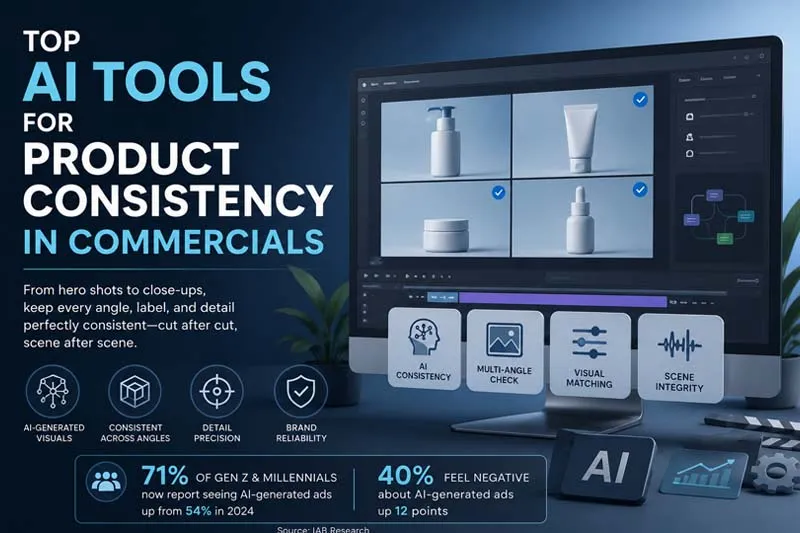
A commercial has a specific, unforgiving version of the product consistency problem: the same bottle, box, or device has to survive a hero shot, a three-quarter angle, a close-up on the label, and a rotating reveal, all cut together into 15 or 30 seconds, without a viewer ever registering that anything looks slightly off between cuts. This bar matters more than it used to. Per IAB research, 71% of Gen Z and Millennial consumers now report seeing AI-generated ads, up from 54% in 2024, and 40% feel negative about them, up 12 points, which means a commercial that looks even slightly inconsistent risks reading as obviously synthetic to an increasingly AI-literate audience.
Comparison table
| Tool | Best for | Product consistency mechanism | Starting price |
|---|---|---|---|
| invideo agent | Turning a set of product reference photos into a full multi-shot commercial sequence | Money Shot feature plus a two-stage base-scene and product-locking pipeline | $17/month; team and enterprise options available |
| Nightjar | A large product catalog that needs to look like one commercial shoot | Reusable Photography Styles and Compositions anchored on real product photos | ~$25/month |
| Claid.ai | On-model fashion commercials with preserved texture and branding | Custom AI model training per brand catalog | $9/month |
| Creatify | High-volume commercial variants generated from a product URL | AI actors holding the same product across dozens of ad variants | Free plan; $39/month |
| ChatCut | Building a full reference "master sheet" for a recurring product or character | Up to 14 reference images accepted per generation on its Pro tier | Usage-based |
| Adobe Firefly | Commercials needing lower legal exposure on generated imagery | Trained on a licensed dataset rather than scraped images | $4.99/month |
| Synthesia | A consistent spokesperson demonstrating a product across many markets | 140+ avatars and 120+ languages for scaled international commercials | $29/month |
| Midjourney | Developing a distinctive hero concept before committing to full production | Strong aesthetic control for mood boards and hero imagery | ~$10/month |
| Botika | Bulk flat-lay-to-model conversion for fashion commercials at scale | Automatic brand retouching rules applied across every generated image | $22/month |
| Photoroom | Fast, consistent batch editing for individual sellers | Batch Mode for catalog-wide framing and styling | $7.50/month |
1. invideo agent
invideo agent is built specifically around the problem a commercial creates: taking a handful of real product photos and turning them into a full, multi-shot sequence where the product never drifts between cuts. Its Money Shot feature takes four to eight reference images, a straight-on hero angle, a three-quarter angle, a side profile, and a couple of strong close-ups showing branding and texture, and turns that image set into a complete commercial sequence with transitions, effectively acting as a director's assistant that plans which angle does which job in the final cut while keeping the product consistent throughout.
The mechanism behind this is a persistent context engine paired with a two-stage pipeline: a base scene is built in one model first, then a dedicated product-locking model, such as Nano Banana, locks the exact product into the finished frame, regardless of which of the platform's 200+ integrated models, including Veo 3.1, Sora 2, Kling 3.0, Seedance 2.0, Runway, PixVerse, Hailuo, WAN, Recraft, GPT Image 2.0, and Nano Banana, renders that particular shot. Camera Controls let a director apply a deliberate move, a slow rotation, a push into a label close-up, as a planned decision that still holds the product steady.
Best for: turning a set of real product reference photos into a complete, multi-shot commercial with the product held consistent across every angle and cut.
Where it falls short: the reference-and-lock workflow asks for genuine product photography at multiple angles upfront, which is more setup than a single hero image, though that step is what buys the consistency a commercial needs.
Pricing: plans start at $17/month, with team and enterprise options also available.
2. Nightjar
Nightjar builds every generated product image from reusable ingredients, a Photography Style for lighting and color, a Composition for framing, anchored on real product photos a brand uploads, so a whole catalog of commercial stills reads as one consistent shoot.
Best for: e-commerce catalogs of dozens to thousands of SKUs needing commercial-grade photography that looks like one shoot.
Where it falls short: it's built for still photography rather than video, so it typically feeds a video tool rather than producing the finished commercial itself.
Pricing: paid plans from roughly $25/month for 150 generations.
3. Claid.ai
Claid.ai's AI Fashion Models feature renders garments on realistic models while explicitly preserving texture, logos, and branding details, with custom AI model training letting a brand train the platform on its own catalog for consistent commercial output over time.
Best for: fashion and retail commercials where fabric texture and branding details have to survive AI generation.
Where it falls short: custom model training sits behind the Pro tier, and there's no structured bulk pipeline for very large catalogs.
Pricing: Essentials plan from $9/month.
4. Creatify
Creatify pulls product details automatically from a product page URL, then builds commercial-style video ad drafts using AI actors that keep the same product consistent across dozens of variants, suited to volume testing over a single polished hero commercial.
Best for: performance marketers testing many product commercial variants quickly, starting from an existing listing.
Where it falls short: the avatar pool is comparatively small, and the volume-first design trades some per-shot polish for speed.
Pricing: free plan with 10 monthly credits; Creator plan from $39/month.
5. ChatCut
ChatCut's integration of GPT Image 2 accepts up to 14 reference images per generation on its Pro tier, enough to build a proper master reference sheet, multiple angles, lighting conditions, and detail shots, for a product or recurring brand character that needs to hold up across a full sprint of weekly commercial variants.
Best for: brands shipping a new commercial creative every week that need a deep, reusable reference sheet rather than a single hero shot per cycle.
Where it falls short: it's model-access infrastructure more than a turnkey commercial production tool, so it suits a technical team comfortable managing reference sheets directly.
Pricing: usage-based.
6. Adobe Firefly
Firefly is trained on a licensed dataset rather than scraped imagery, which significantly reduces legal exposure for a commercial destined for paid, wide-reaching distribution, a real consideration creative departments weigh before generative imagery goes into broadcast or connected TV placement.
Best for: commercials where reduced legal exposure on generated imagery is a hard requirement before distribution.
Where it falls short: for exact product accuracy in a hero shot, some practitioners still prefer traditional editing of real photography over any generative model.
Pricing: Premium plan from $4.99/month.
7. Synthesia
Synthesia's scale, 140+ avatars and 120+ supported languages, suits a brand that needs a consistent spokesperson demonstrating a product the same way across many international markets and commercial cuts.
Best for: brands that want a human or avatar presenter demonstrating a product consistently across many languages and markets.
Where it falls short: the presenter-led format isn't the right fit for a pure product-hero commercial where no avatar or spokesperson should appear in frame.
Pricing: Starter plan from $29/month.
8. Midjourney
Midjourney remains a strong first stop for developing a distinctive hero concept, mood, polish, and a strong point of view for a commercial's key visual, before that concept moves into a production-ready pipeline built around consistency.
Best for: developing a commercial's hero concept, mood board, or key visual identity before committing to full production.
Where it falls short: it's a concept and hero-imagery tool rather than a production platform built around holding a product consistent across many commercial shots.
Pricing: plans start around $10/month.
9. Botika
Botika converts flat-lay or ghost-mannequin product photos into images of AI-generated models wearing the garment at catalog scale, with predefined brand retouching rules applied automatically across every generated image.
Best for: bulk conversion of flat garment photos into consistent, commercial-ready on-model imagery.
Where it falls short: reviewers note limited pose control and inconsistent results on complex, layered, or heavily printed garments.
Pricing: Lite plan from $22/month for 30 credits.
10. Photoroom
Photoroom's Batch Mode processes hundreds of product images at once with consistent framing and styling, paired with marketplace-ready templates, which suits fast, consistent commercial stills for individual sellers rather than a full broadcast production.
Best for: individual resellers processing commercial product photos quickly from a phone.
Where it falls short: it's less suited to the complex lighting consistency a full video commercial needs compared with dedicated catalog or video systems.
Pricing: Pro plan from $7.50/month.
Which one should you use
- A full multi-shot commercial built from a set of product reference photos → invideo agent
- A large catalog that needs to look like one commercial shoot → Nightjar
- On-model fashion commercials with preserved texture → Claid.ai
- High-volume commercial variants from a product URL → Creatify
- A deep, reusable reference sheet for weekly commercial output → ChatCut
- Reduced legal exposure on generated commercial imagery → Adobe Firefly
- A consistent spokesperson across many markets → Synthesia
- Developing a distinctive hero concept before production → Midjourney
- Bulk flat-lay-to-model conversion at scale → Botika
- Fast, consistent batch editing for individual sellers → Photoroom
Frequently asked questions
How many reference photos does a product actually need for a consistent commercial?
Four to eight is generally the sweet spot: a straight-on hero angle, a three-quarter angle, a side profile, and a couple of strong close-ups showing branding and texture. That range gives an AI model enough information to understand the product's three-dimensional form, which is what produces smooth transitions and consistent visuals across a generated commercial rather than a flat, single-angle result.
Does audience skepticism about AI-generated ads actually matter for a commercial?
Yes, and it's measurable. IAB research found 71% of Gen Z and Millennial consumers now report seeing AI-generated ads, up from 54% in 2024, with 40% feeling negative about them, a 12-point increase. A Gartner survey of 1,539 US consumers separately found 50% would prefer to buy from brands that avoid generative AI in consumer-facing content, which raises the bar for product consistency specifically, since visible drift is one of the clearest tells that an ad was AI-generated.
Which tool is best for a commercial with a spokesperson demonstrating the product?
Synthesia is built for exactly this, with 140+ avatars and 120+ languages for a presenter that stays consistent across many international commercial cuts, though its avatar-led format isn't the right choice for a pure product-hero shot with no presenter in frame.
Is generated commercial imagery legally safe to broadcast?
It depends on the tool's training data. Adobe Firefly is trained on a licensed dataset specifically to reduce legal exposure, which matters more for a commercial headed to broadcast or connected TV than for a quick social test. Creative teams are generally advised to review any generative tool's terms of service and ownership rights before wide commercial distribution.
Is product-consistent commercial generation free to test?
Several tools offer starting points, including Creatify (10 monthly credits), Photoroom (250 monthly exports with watermark), and Nightjar's starting credit grant, though full resolution, commercial licensing, and broadcast-ready output typically require a paid plan.

Get posts in your inbox
One email a week — new guides, comparisons and the AI tool news actually worth reading.
✓ You're subscribed — check your inbox to confirm.