

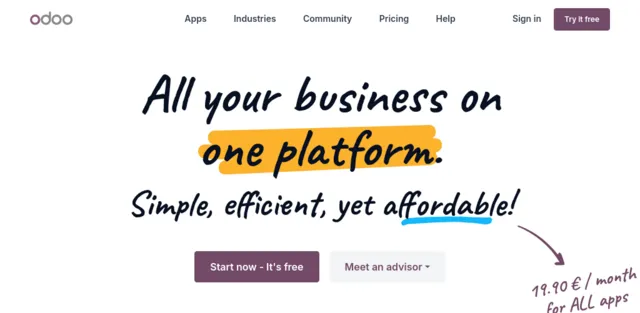
Odoo is a collection of open-source applications designed for efficient business management. Odoo offers a comprehensive set of integrated applications to streamline various business processes. Covering everything from CRM, eCommerce, accounting, inventory, and point of sale (POS) to project management and human resources, Odoo is designed to cater to businesses of all sizes. Its modular architecture allows users to select specific apps based on their needs, making it highly customizable and scalable. It is available in two editions: Community (free, open-source) and Enterprise (paid, with advanced features).

Odoo: Streamlined Business Management for All
Odoo is an adaptable, open-source platform for business management, delivering a collection of interconnected applications to enhance efficiency across organizations of varying scales. It provides solutions for handling tasks such as sales, customer relations, stock management, bookkeeping, and more, all unified in one system. Its modular structure allows users to choose specific tools, like eCommerce, project tracking, or human resources, and integrate them smoothly for optimized operations. With an intuitive interface and customizable options, Odoo is a robust choice for improving business workflows, offered in both a free Community version and a premium Enterprise edition.
Who Can Use Odoo?
Odoo is designed for a wide range of users, including:
- Small Businesses and Startups: To manage core functions like sales, invoicing, or inventory cost-effectively.
- Medium and Large Enterprises: For comprehensive ERP solutions with multi-department integration.
- Retail and eCommerce Owners: To handle online stores, POS, and inventory management.
- Manufacturers: For production planning, shop floor management, and supply chain tracking.
- Service-Based Companies: To manage projects, timesheets, and client billing.
- Freelancers and Consultants: For simplified CRM, invoicing, or task management.
- Nonprofits and Educational Institutions: To streamline administrative tasks and budgeting.
- Developers and IT Teams: To customize apps or integrate with third-party systems.
Key Features of Odoo
- Modular Architecture: Over 70 apps, including CRM, eCommerce, accounting, inventory, POS, project management, and HR.
- Odoo Studio: A no-code tool for creating custom apps, workflows, and reports.
- Seamless Integration: Supports integrations with payment gateways, shipping carriers, and third-party apps via APIs.
- Cloud and On-Premise Hosting: Offers Odoo Online, Odoo.sh, or on-premise hosting for flexibility based on business needs.
- Automation and AI: Automated bank synchronization, invoice parsing, and AI-driven expense scanning reduce manual tasks and boost efficiency.
- Scalability: Suitable for businesses of all sizes.
- Open-Source Community: Access to 40,000+ community apps and a global developer network for continuous innovation and support.
- Fast Performance: Operations executed in under 90ms, with a user-friendly interface optimized for productivity.
Use Cases of Odoo
- Retail and eCommerce: Manage online stores, inventory, and customer portals with integrated POS and eCommerce modules.
- Manufacturing: Streamline production with Odoo’s manufacturing app, supporting bills of materials, shop floor management, and inventory tracking.
- Professional Services: Use project management, timesheets, and invoicing to manage client projects and billing efficiently.
- SMEs and Startups: Leverage the free Community edition or One App Free plan for cost-effective CRM, accounting, or inventory management.
- Large Enterprises: Utilize the Enterprise edition with multi-company support and advanced customizations for complex operations across industries.
Pros of Odoo
- Comprehensive suite of over 70 integrated apps covering all business needs.
- Highly customizable with Odoo Studio and open-source flexibility.
- Cost-effective pricing.
- Fast performance with operations under 90ms and a user-friendly interface.
- Strong community support with 40,000+ apps and global developer collaboration.
- No vendor lock-in, with full access to source code and PostgreSQL data.
Cons of Odoo
- Support can be slow, with reported delays in issue resolution, especially for Community edition users.
- Complex customizations may require expert assistance, increasing implementation costs.
- The learning curve for advanced features and Odoo Studio can be steep for beginners.
- Odoo.sh hosting costs can be prohibitive for small businesses or single-user accounts.
- Some basic features in competing ERPs may require third-party apps, adding to costs.
 Odoo pricing 2026: Plans, Features, and Subscription Costs Explained
- Free
- $0
- Standard
- $31.10/user/month
- Custom
- $46.70/user/month
 Odoo Reviews & Ratings: See What Users and Experts Are Saying
 Odoo Alternatives 2026: Comparing Top Enterprise Resource Planning Platforms








 Odoo FAQ: Learn How to Use It, Troubleshoot Issues, and More
Streamlines business processes with integrated apps for CRM, ERP, accounting, and more.
No, Odoo is a Belgian company headquartered in Grand-Rosière, Belgium.
No, Odoo is Belgian but has an office in Gandhinagar, India.
Odoo for customization, ERP; Zoho for simplicity, SMB-focused solutions.
Visit www.odoo.com, click "Sign In" to access your account.
The official website is www.odoo.com for apps, pricing, and support.
Odoo India offers GST-compliant ERP via its Gandhinagar office.
Odoo SA is a Belgian company developing Odoo software globally.
Modular tools for CRM, accounting, eCommerce, inventory, and more.
Belgian software firm providing open-source business management solutions.
Download the Community edition from www.odoo.com or GitHub.


