In this article
You have probably used a chatbot that answers questions. You type, it replies, and that is the end of it. An AI agent goes a step further: you give it a goal, and it figures out the steps, uses tools, and gets the work done with very little hand-holding. This guide explains what AI agents are, how they work, and where you can already see them in everyday life.
What Are AI Agents?
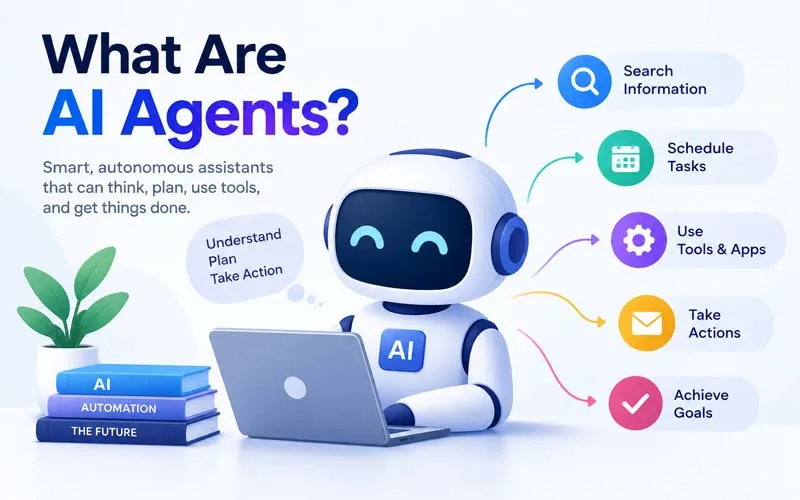
An AI agent is a software system that can understand a goal, decide what to do next, take actions, and check the results on its own. Instead of waiting for a new instruction at every step, it keeps working until the task is finished or it needs your input.
A simple way to picture it: a regular AI chatbot is like a knowledgeable friend you can ask questions. An AI agent is more like a capable assistant you can hand a job to, such as "find three flights under a set budget and put the best option in my calendar."
AI Agent vs. Chatbot vs. Automation: What Is the Difference?
These three terms are often mixed up, so here is a quick comparison.
| Feature | Chatbot | Traditional Automation | AI Agent |
|---|---|---|---|
| Main job | Answers questions | Repeats fixed steps | Pursues a goal |
| Handles surprises | Limited | Usually breaks | Adapts its plan |
| Uses tools | Rarely | Pre-set only | Chooses tools as needed |
| Needs step-by-step instructions | Yes | Yes | No, a goal is enough |
How Do AI Agents Work?
Most modern AI agents are built around a large language model (LLM) and follow a repeating loop. Understanding this loop makes the whole idea much less mysterious.
- Goal: You describe what you want in plain language.
- Planning: The agent breaks the goal into smaller steps.
- Action: It uses tools such as a web search, a calculator, a calendar, a database, or a code editor to complete a step.
- Observation: It looks at what happened and decides whether the step worked.
- Adjustment: If something failed, it tries another approach. If everything worked, it moves on until the goal is complete.
The Key Building Blocks
- The model (the brain): Reasons about the task and decides what to do next.
- Tools: Let the agent act in the real world, for example sending an email or searching a website.
- Memory: Helps it remember earlier steps in a task, and sometimes your preferences over time.
- Guardrails: Rules that limit what the agent is allowed to do, so it stays safe and on task.
Types of AI Agents
Not every agent is equally smart. Researchers usually group them by how they make decisions:
- Simple reflex agents: React to the current situation using fixed rules. A thermostat that turns the heating on below a set temperature is a classic case.
- Goal-based agents: Choose actions that move them closer to a defined target, such as a navigation app finding a route to your destination.
- Utility-based agents: Weigh several options and pick the best trade-off, for example balancing price, speed, and comfort when recommending a trip.
- Learning agents: Improve over time by learning from feedback and past results.
Real Examples of AI Agents You Can See Today
AI agents are no longer just a research idea. Here are practical places they already show up.
1. Customer Support Agents
Many companies now use agents that read a customer's message, look up the order status, check the refund policy, and either resolve the issue or pass it to a human with a clear summary. This saves customers from repeating themselves.
2. Coding Agents
Developer tools can now read a codebase, write a new feature, run the tests, notice a failure, and fix it. The developer reviews the result rather than typing every line, which speeds up routine work like bug fixes and refactoring.
3. Research and Analysis Agents
A research agent can search multiple sources, compare the findings, and produce a structured summary with references. What used to take an afternoon of tab-hopping can be reduced to a short review.
4. Personal Productivity Agents
Some assistants can sort your inbox, draft replies, schedule meetings by checking everyone's availability, and remind you about follow-ups. You stay in control, but the busywork is handled for you.
5. Travel Planning Agents
Give an agent your dates, budget, and interests, and it can compare options, build an itinerary, and flag conflicts such as a tight flight connection.
6. Sales and Marketing Agents
Agents can research prospects, personalise outreach messages, update a CRM, and schedule follow-ups, helping small teams do the work of a larger one.
7. Everyday Smart Devices
A robot vacuum that maps your home, avoids obstacles, and returns to charge itself is a good everyday example of an agent that senses its environment and acts on it.
Benefits of AI Agents
- Time savings: They handle repetitive, multi-step tasks without constant supervision.
- Availability: They can work around the clock.
- Consistency: They follow the same process each time, reducing careless errors.
- Scalability: One well-built agent can support thousands of users at once.
Limitations and Risks to Keep in Mind
AI agents are powerful, but they are not perfect. Beginners should be aware of a few challenges:
- Mistakes happen: Agents can misunderstand a goal or produce incorrect information, so important results should be reviewed.
- Over-permission: Giving an agent access to email, payments, or private files without limits can cause real damage if something goes wrong.
- Privacy: Be careful about what data you share, especially sensitive business or personal information.
- Cost and complexity: Multi-step agents can use more resources than a single chatbot reply.
A good rule of thumb is to keep a human in the loop for anything high-stakes, such as spending money, deleting data, or sending messages on your behalf.
How to Get Started With AI Agents
- Pick one small, repetitive task. Examples include summarising meeting notes or sorting support emails.
- Define a clear goal. Explain what a successful result looks like.
- Start with limited access. Let the agent read first and act later.
- Review the output. Check its work, note where it struggles, and improve your instructions.
- Expand gradually. Once you trust it on one task, add the next.
The Future of AI Agents
Agents are moving from single tasks toward teams of specialised agents that cooperate, with one researching, another writing, and a third checking quality. As the technology matures, expect better reliability, clearer controls, and more tools designed specifically for agents. Learning the basics now will help you use them confidently as they become part of everyday work.
Frequently asked questions
Is ChatGPT or Claude an AI agent?
A chat assistant on its own mainly answers questions. It becomes agent-like when it is allowed to plan steps and use tools such as search, files, or code to complete a task on your behalf.
Do I need to know coding to use AI agents?
No. Many agent tools today work through plain-language instructions. Coding helps if you want to build a custom agent, but it is not required to use one.
Will AI agents replace jobs?
Agents are better at taking over repetitive tasks than entire roles. In most cases they change how work is done, freeing people to focus on judgement, creativity, and relationships.
Are AI agents safe to use?
They can be, when you limit their permissions, protect sensitive data, and review important actions before they happen.
Get posts in your inbox
One email a week — new guides, comparisons and the AI tool news actually worth reading.
✓ You're subscribed — check your inbox to confirm.