In this article
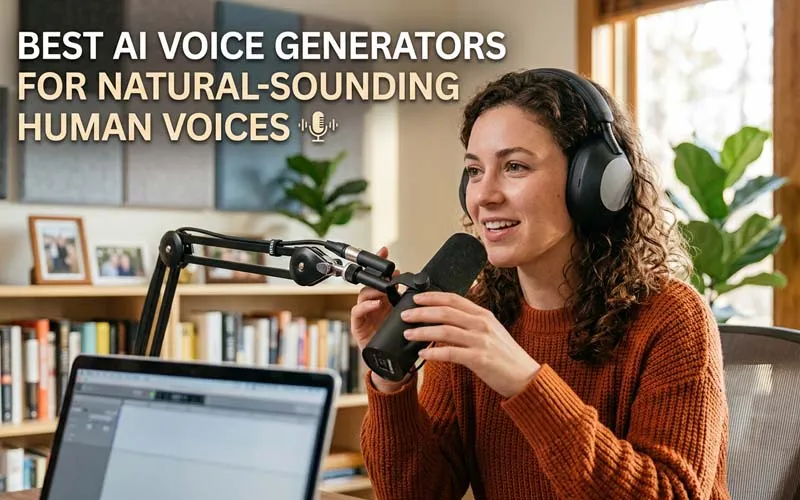
Not long ago, you could spot a computer-generated voice within two seconds. The rhythm was flat, the stress landed on the wrong words, and every sentence ended the same way. Today the picture is very different. Leading text-to-speech models breathe, pause, whisper, laugh and change tone in the middle of a sentence, and in short blind listening tests many people cannot reliably tell them from a recorded human.
The catch is that almost every vendor now claims to sound "human." This guide tries to cut through that. It is based on a review of independent blind-listening leaderboards, vendor documentation and current pricing pages as of late October 2026. Instead of one long ranked list, the tools are grouped by the job they do: narration and creator content, business voiceovers, real-time voice agents and app development, voice cloning, listening and accessibility, and open-source models you can run yourself.
Quick Summary: Which AI Voice Generator Should You Pick?
| Your main goal | Tools worth a look | Best for |
|---|---|---|
| Expressive narration, audiobooks, YouTube | ElevenLabs, Hume AI | Creators who need emotion and range |
| Business voiceovers, training, explainers | Murf AI, WellSaid Labs, LOVO | Marketing, L&D and course teams |
| Voice agents and in-app speech | Cartesia, Google Gemini TTS and Cloud Text-to-Speech, OpenAI TTS, Microsoft Azure AI Speech, Amazon Polly | Developers and product teams |
| Voice cloning | ElevenLabs, Resemble AI, Descript | Creators and brands with consent |
| Listening to articles, PDFs and books | Speechify, built-in read-aloud tools | Students, professionals, accessibility |
| Free and self-hosted | Kokoro, Chatterbox, Fish Audio, Dia, Sesame CSM | Developers who want control and no per-character fees |
Note: This market moves fast. Models are replaced every few months, plans are renamed and prices shift, and different review sites often quote different numbers for the same plan. Treat any price in this article as a rough guide and confirm it on the vendor's own pricing page before you pay.
What Actually Makes an AI Voice Sound Human?
Knowing what to listen for makes every comparison easier. Human speech has qualities most of us never consciously notice until they are missing:
- Prosody: the rise and fall of pitch, the rhythm of a sentence and which words get stress. Flat prosody is the biggest giveaway of a weak voice.
- Pacing and pauses: people slow down for important points and pause before a surprise. Robotic voices keep one constant speed.
- Breath and small sounds: soft inhales and tiny hesitations suggest a body behind the voice.
- Context awareness: a good model knows "read" sounds different in "I read it yesterday" than in "I read it daily," and that a question needs a rising tone.
- Emotional range: the same sentence should sound different when delivered with excitement, sadness or sarcasm.
- Consistency over length: plenty of voices sound excellent for 20 seconds and drift, glitch or lose character over ten minutes.
Older text-to-speech stitched together pre-recorded sound fragments. Modern systems use neural networks trained on large amounts of speech and generate the audio directly, which is why the output flows instead of sounding chopped up. Many newer models also accept inline instructions or tags, such as asking for a calm, tired or cheerful delivery, which gives you director-style control over a read.
How the Blind Listening Leaderboards Change the Picture
Marketing pages and "best of" lists tend to repeat the same names. A better reality check comes from blind arenas, where listeners hear two clips of the same text without knowing which model made them and vote for the more natural one. The Artificial Analysis Speech Arena is the most widely cited example, and it ranks dozens of models using an Elo-style rating, the same approach used in chess.
Three things stand out when you look at these rankings over 2026:
- The top spots rotate. At different points this year, leading positions have been held by Google's Gemini TTS models, Cartesia's Sonic line, Speechify's Simba model and other newer entrants. The gaps at the top are often small, and the confidence ranges overlap, so a rank of first versus third may not be a meaningful difference.
- Popularity is not the same as rank. ElevenLabs is the name most creators reach for, and it is praised for its voice library and workflow, yet it does not always sit at number one in blind tests. A tool can be the best product for your project without topping a leaderboard.
- Open models are catching up but not there yet. In a May 2026 snapshot, every model in the overall top ten was a closed commercial system, while the best open-weight model, Fish Audio S2 Pro, ranked around eleventh. That is a remarkable gap closure compared with a couple of years ago.
The practical lesson: use leaderboards to build a shortlist, then judge with your own script and your own ears.
Best AI Voice Generators for Expressive Narration
1. ElevenLabs: Best All-Round Platform for Creators
ElevenLabs is the most widely used name in the creator space, and the reasons are practical. It has a very large voice library, support for dozens of languages, voice design from a text prompt, instant and professional voice cloning, dubbing, and a projects editor for long-form work. Its newer v3 model is known for expressive delivery and supports inline audio tags to steer emotion, while faster models such as Flash trade some expressiveness for speed. Reviewers note a clear gap between the two: v3 has the wider emotional range, and Flash is better when latency matters.
Pricing and licensing to know: there is a free tier with roughly 10,000 credits a month, which works out to around ten minutes of speech, but it does not include a commercial licence and requires attribution. Paid plans start at roughly $5 to $6 a month and add commercial rights and instant cloning, with professional voice cloning arriving around the Creator tier. Higher-fidelity audio options for publishing platforms sit on more expensive plans. Credits usually expire monthly, and conversational agents can consume credits quickly.
Good to know: great for creators, but if raw blind-test naturalness or the lowest possible latency is your only goal, check the alternatives below.
2. Hume AI: Best for Emotionally Aware Speech
Hume builds speech around emotion. Its text-to-speech and Empathic Voice Interface let you describe how a line should be delivered and design voices from a written description. It suits wellness apps, companions, characters and any product where tone is the point.
Good to know: it is more developer-oriented than a drag-and-drop studio and has a smaller catalog than the biggest consumer platforms.
Best AI Voice Generators for Business Voiceovers
These products wrap speech models in an editor built for people who produce training, explainers, ads and presentations rather than software.
3. Murf AI: Best Studio-Style Editor with Fine Control
Murf is a Bengaluru-based company that pairs a large voice catalog with a timeline editor. You can adjust pitch, emphasis, pauses and speed at the word level and sync narration to slides or video. In August 2026 the company announced Falcon 2, a newer speech model aimed at developers and real-time agents, with per-minute pricing advertised at around one US cent. The earlier Falcon model was positioned around very low latency of roughly 55 milliseconds.
Good to know: Murf has changed its plan lineup several times in 2026, and published prices vary by source and by billing period. Check the live pricing page and confirm which voices and commercial rights come with your plan.
4. WellSaid Labs: Best for Compliance-Minded Teams
WellSaid focuses on a clean, professional read for training, product walkthroughs and internal communication. Its selling points are voices built from licensed voice actors and enterprise-grade security, including SOC 2 compliance. The company has moved to the wellsaid.io domain.
Good to know: the style leans polished and neutral rather than dramatic, so it is less suited to character-heavy storytelling.
5. LOVO (Genny): Best for Voice Plus Video Editing in One Place
LOVO combines a wide voice library, many languages and a video editor with subtitles and stock media. Reviewers describe a catalog of several hundred voices across a very large number of languages, which suits agencies and freelancers handling many short projects.
Good to know: language count is not the same as language quality. Test each language and accent you actually need.
Best AI Voice APIs for Developers and Voice Agents
If you are building an app, phone bot or assistant, you care about latency, reliability and cost per character as much as sound quality.
6. Cartesia (Sonic): Best for Real-Time Conversation
Cartesia's Sonic models are built for speed. Reviews describe response times under 100 milliseconds for earlier versions, and the Sonic line has repeatedly ranked near the top of blind listening arenas. That combination of naturalness and low latency makes it a common pick for live voice agents.
7. Google Gemini TTS and Cloud Text-to-Speech: Best for Scale, Languages and Prompt-Style Control
Google offers a broad catalog of voices and languages on its cloud platform, and its newer Gemini -based speech models have ranked at or near the top of blind tests in 2026. They accept natural-language style prompts, so you can ask for a certain pace or mood. This is an attractive route if you already build on Google Cloud.
8. OpenAI Text-to-Speech: Best for Simple Integration
OpenAI's speech models are easy to drop into existing projects and support streaming, plus instruction-style control over tone and delivery. They pair naturally with language models when you are building voice assistants.
9. Microsoft Azure AI Speech and Amazon Polly: Best for Enterprise Reliability
Both are mature cloud services with wide language coverage, pay-as-you-go pricing and SSML controls for pronunciation, pauses and emphasis. Their top neural voices sound far better than the old standard voices. They may not win expressive storytelling comparisons, but they are dependable choices when uptime, compliance and predictable scaling matter most.
Best AI Voice Generators for Voice Cloning
Voice cloning builds a synthetic version of a specific voice from a sample recording. It is useful for creators who want to scale their own narration, and it is also the area with the most legal and ethical risk.
10. Resemble AI: Best for Cloning with Built-In Safeguards
Resemble offers cloning, speech-to-speech conversion and, notably, tools for watermarking and detecting synthetic audio. That focus on provenance suits companies that need cloning with an audit trail. The same company released the open-source Chatterbox model, which embeds a watermark in its output.
11. Descript: Best for Fixing Mistakes by Typing
Descript lets you edit audio and video by editing a transcript. With a cloned version of your own voice, you can correct a flubbed word or insert a missing sentence without re-recording. It is a practical fit for podcasters, course creators and anyone who records their own narration.
12. ElevenLabs: Best Library of Cloning Options
ElevenLabs offers both quick instant cloning from a short sample and professional cloning with a longer, verified recording. As with every platform, consent requirements apply, and public-figure voices are generally blocked.
Best AI Voice Generators for Listening and Accessibility
13. Speechify: Best for Reading Anything Aloud
Speechify began as a reader for web pages, documents and PDFs and is widely used by students and people with dyslexia or other reading difficulties. In July 2026 it also drew attention when its Simba 3.2 model was reported to have reached the top of the Artificial Analysis leaderboard, which shows how quickly the line between "reader app" and "serious voice model company" is blurring.
14. Built-in Read-Aloud Tools: Best Free Option
Browsers, phones and operating systems now include neural read-aloud voices. They are not as expressive as paid tools, but they cost nothing and are good enough for casual listening.
Best Free and Open-Source Text-to-Speech Models
If you are technical and want control, privacy or zero per-character fees, open models have improved enormously. Always check the licence before using one commercially.
- Kokoro: a very small model of around 82 million parameters that is fast and surprisingly natural, released under the Apache 2.0 licence. It is among the best speed-to-quality options.
- Chatterbox: from Resemble AI, released under the MIT licence, strong at cloning from a short reference clip and includes an audio watermark.
- Fish Audio S2 Pro: the highest-ranked open-weight model on the Artificial Analysis arena at the time of research, and competitive in customer-service style reads.
- Dia: built for multi-speaker dialogue, including non-verbal cues such as laughter and pauses.
- Sesame CSM and CosyVoice 2: Sesame focuses on expressive, conversational delivery, while CosyVoice 2 is known for multilingual quality and cloning.
- Orpheus: built on a Llama architecture with emotion tags, but it carries Llama licence terms, including attribution.
The trade-off: you need a capable machine or server, some engineering time, and you take responsibility for safety and licensing. For most non-developers, a hosted tool is simpler.
Pricing and Licensing Traps to Avoid
- Free does not mean commercial. Free plans often forbid monetized or client use, and some require attribution. Using free-tier audio in a paid project is one of the most common mistakes.
- Credits are not minutes. One platform's credit can equal a character, a second or part of a minute, depending on the model you choose. Always convert to cost per finished minute.
- Credits often expire. Unused monthly credits usually do not roll over.
- Quality tiers differ. Higher audio fidelity, required by some audiobook and music platforms, can sit on higher plans.
- Agent use burns budget. Live conversational use can consume far more usage than a one-off narration.
- Prices are unstable. Vendors restructured plans repeatedly in 2026, so a table from three months ago may already be wrong.
Consent, Disclosure and the Law
Realistic voices come with real responsibilities. Rules differ by country and are still developing, so treat the following as general orientation, not legal advice.
- Only clone voices you have permission to use. Several US states have moved to protect voice likeness; Tennessee's ELVIS Act, effective in July 2024, explicitly extends personal rights to AI-generated voice replicas. A proposed federal NO FAKES Act, introduced in April 2025, would create nationwide rights over digital replicas, but check whether it has passed before relying on it.
- AI voices in phone outreach need consent. In 2024 the US Federal Communications Commission ruled that AI-generated voices in robocalls fall under existing telemarketing consent rules.
- Disclosure rules are arriving. The EU AI Act includes transparency obligations for AI-generated audio, with key provisions reported to apply from August 2026. If you publish in or to the EU, confirm what applies to you.
- Labelling is not the same as consent. Telling listeners a voice is synthetic does not give you the right to imitate a real person.
- Never use voices to deceive. Fake endorsements, impersonation and scam calls are illegal in many places and violate every reputable platform's terms.
How to Test an AI Voice Before You Pay
- Use your real script. Include names, numbers, dates, abbreviations and a question, since those are where voices stumble.
- Generate two or three minutes. Listen for drift, repeated phrasing and sudden tone shifts.
- Listen on headphones and on a phone speaker. Some flaws appear in only one.
- Test your brand and industry terms. Check whether the tool offers a pronunciation dictionary or SSML.
- Try different emotions. Make the same line cheerful, serious and urgent.
- Test your languages and accents. Do not assume English quality carries over.
- Do a blind test with friends. Play two versions without labels and ask which sounds more natural.
- Read the licence. Confirm commercial rights, platform restrictions and attribution rules.
Tips for Making AI Voices Sound More Human
- Write for the ear. Short sentences, contractions and everyday words sound far more natural than formal written prose.
- Use punctuation as stage directions. Commas, dashes and line breaks guide pauses. Splitting a long sentence often helps more than switching voices.
- Respell tricky words. If a name is mispronounced, spell it the way it sounds or use the tool's pronunciation controls.
- Use style prompts or tags where supported. Directions such as calm, hushed or upbeat can transform a read, but use them sparingly.
- Generate in sections. Re-render one weak line instead of the entire file.
- Slow the speed slightly. Many voices sound better a few percent slower than default for narration.
- Add light audio polish. Gentle compression, room tone and quiet background music hide small artifacts and help the voice sit in a mix.
- Listen cold. Wait an hour, then play it back like a stranger. Awkward moments become obvious.
How to Choose the Right Tool
- Start with the use case. A podcast narrator, a training video and a live phone agent need different strengths.
- Decide how much control you need. Editors are faster; APIs and open models offer more precision.
- Weigh latency if the voice is live. For agents, response time matters as much as realism.
- Check languages and accents. Test each one you need.
- Calculate cost per finished minute. Convert credits and characters into real usage.
- Confirm rights. Commercial use, cloning rules and data handling should be clear in writing.
- Avoid overlap. One strong tool beats three overlapping subscriptions.
Three Sample Voice Stacks
- Beginner or hobbyist: the free tier of a leading generator for testing, plus built-in read-aloud for listening. Move to a paid plan only when you need commercial rights.
- Creator or small business: one expressive generator such as ElevenLabs for narration, Descript for editing, and Murf or LOVO if you need an all-in-one video voiceover editor.
- Product team or agency: a low-latency provider such as Cartesia for live agents, a cloud speech API for scale and language coverage, and a cloning platform with consent controls and watermarking for branded voices.
Final Thoughts
The gap between synthetic and human speech has narrowed faster than almost anyone expected, and the leaderboard at the top changes every few months. That is good news for buyers, because competition keeps quality rising and prices falling. It is also a reason to avoid long contracts and to test current versions rather than trusting a list written last year.
The best results still come from pairing a strong voice with a well-written script and a careful listen. Start with free tiers, test with your own content, confirm the licensing, and only then pay for the tool that fits your workflow.
Frequently asked questions
What is the most natural-sounding AI voice generator?
There is no single permanent winner. ElevenLabs is the most popular choice for creators because of its voice library, cloning and editing tools. In independent blind listening tests such as the Artificial Analysis Speech Arena, the top positions have rotated through 2026 between models from Google, Cartesia, Speechify and others, often with very small gaps. The best approach is to shortlist two or three tools and test them with your own script.
Are there free AI voice generators that sound human?
Yes. Many platforms offer free tiers, and open-source models such as Kokoro and Chatterbox can run on your own hardware at no per-character cost. The main limits are quantity and licensing: free plans on hosted tools often exclude commercial use and may require attribution, so check the terms before using the audio in monetized or client work.
Can I use AI-generated voices on YouTube or in podcasts?
Usually yes, if your plan includes commercial rights. Free tiers often do not allow monetized use. Also review the platform's own policy on synthetic or altered content, because disclosure may be required in some situations.
How does AI voice cloning work?
You provide a recording of a voice, and the model learns its tone, pitch and speaking style so it can generate new speech from text. Some tools can clone from a short sample, while professional cloning uses longer, verified recordings for higher quality. You should only clone your own voice or one you have clear written permission to use.
Is it legal to clone someone's voice with AI?
Not without their consent in many places. Rules vary by country and state, and the law is still evolving. For example, Tennessee's ELVIS Act extends personal rights to AI-generated voice replicas, and the US FCC has ruled that AI voices in robocalls need prior consent. A proposed federal NO FAKES Act would add nationwide protection, but check its current status. This is general information, not legal advice.
What is the difference between text-to-speech and an AI voice generator?
Traditional text-to-speech simply reads text aloud, often in a flat voice. Modern AI voice generators use neural networks that model rhythm, emphasis and emotion, so they sound far closer to a real speaker. Today the two terms are used almost interchangeably.
How can I make an AI voice sound less robotic?
Write short, conversational sentences with contractions, use punctuation to control pauses, respell difficult names phonetically, use style prompts or emotion tags if the tool supports them, generate in small sections, and slow the speed slightly. A little audio polish such as light compression and quiet background music also helps.
Which AI voice generator is best for developers?
It depends on your priority. Cartesia is popular for low-latency voice agents, Google's Gemini and Cloud TTS suit large-scale and multilingual use, OpenAI's speech models are simple to integrate, and Microsoft Azure AI Speech and Amazon Polly are dependable enterprise options. Compare latency, language coverage and cost per character or per minute.
Do AI voice generators support Indian and other regional languages?
Many platforms list dozens of languages, but quality differs widely between them and between accents. Some vendors, such as the Bengaluru-based Murf AI, focus on global business voiceovers, but you should test each language and accent you need before committing, instead of relying on a language count.
Are open-source text-to-speech models good enough to replace paid tools?
For some uses, yes. Models such as Kokoro, Chatterbox and Fish Audio S2 Pro are strong and free to run, and some have permissive licences. In blind tests, though, the top commercial systems still lead, especially for expressive entertainment-style reads. Open models also need technical setup and you are responsible for safety and licensing.
Will AI voices replace human voice actors?
They are taking over high-volume, lower-budget work such as e-learning, explainers and rough drafts, but human actors remain preferred for emotionally complex, brand-defining and performance-heavy projects. Many productions now use both: AI for speed, humans for key moments.
Get posts in your inbox
One email a week — new guides, comparisons and the AI tool news actually worth reading.
✓ You're subscribed — check your inbox to confirm.